
13 Years a Citizen.
an American semi-quincentennial story, with way too many Will Smith references.

At the tail end of 2017 I released my second book “Jesus Is Black.” it was a collection of stories dealing with race in America, told from the experiences of a recently naturalized Black immigrant - me. In the past few weeks, a couple copies were sold, as I prepared to ship said copies, I sent emailed updates.
I Google myself frequently, it helps me keep the LinkedIn account up to date. I frequently fail at reflection, I find that this habit helps me keep track of articles, events and happenings I’ve mentally zoomed by. I’m also a fan of precision, I want to get it right, remembering which letters were capitalized, etc. Almost a decade after putting the book into the world, I’m still obsessive about ensuring that I write the title correctly in my emails. With that in mind, for the first time, rather than putting my name in the search bar, I typed the title of my book. The unwanted “A.I. Overview” read the following:
“Jesus Is Black. is a thought-provoking 2017 book by Jamaican-American author, educator and community advocate Patrick “Rico” Williams. It uses vivid storytelling and humor to explore the intersections of Blackness and the Black American experience, often drawing relatable, culturally resonant parallels between biblical stories and Black culture.”
- I don’t think we’ve figured out how to source A.I. quotes yet.
I’ll be honest, I’ve been largely averse to Artificial Intelligence since Will Smith’s “I, Robot,” but it’s hard to deny how comprehensive of a synopsis that was. What struck me however was the phrase “Jamaican-American,” it felt (and still feels) foreign. It isn’t a title I carry, it isn’t a thing I’ve ever said, I never yearned for this, echoing the sentiments of Will’s TV dad, Lou, “you think I want this? It just happened.” It was a means to an end, a reclamation project.
I don’t know how it feels to be American.
“If now isn’t a good time for the truth, I don’t see when we’ll get to it.”
- Nikki Giovanni
As I’m sure you’ve heard, this year America is celebrating it’s 250th year. The nation’s cities and towns are adorned with red, white and blue bunting flags. All major television commercials now feature an “America 250” logo somewhere in the lower third. Disney, a quintessential American brand honors the nation by providing 24 hours of television programming across all of their networks. A fitting tribute, because what’s more American than an entire day of couch rotting?
As an immigrant, as a Black person, as someone with eyes, I’ve never felt tethered to the American experience. America exists as a group project where those who’ve done the heaviest lifting are largely left out of the spoils. It’s difficult to celebrate the 250th anniversary of a document that says “all men are created equal” but later reduces Black personhood to a mere fraction. The result of a Revolutionary War fought to reduce Britain’s portion of the American pie. Angered at heavy taxes imposed from the other side of the globe, cutting too deeply into profits from the toil of Black bodies, dissenters began an eight year war. With Crispus Attucks, an African American, holding the distinction of being it’s first casualty.
For a lot of us, just like Kobayashi, we show up to July fourth for the glizzies.
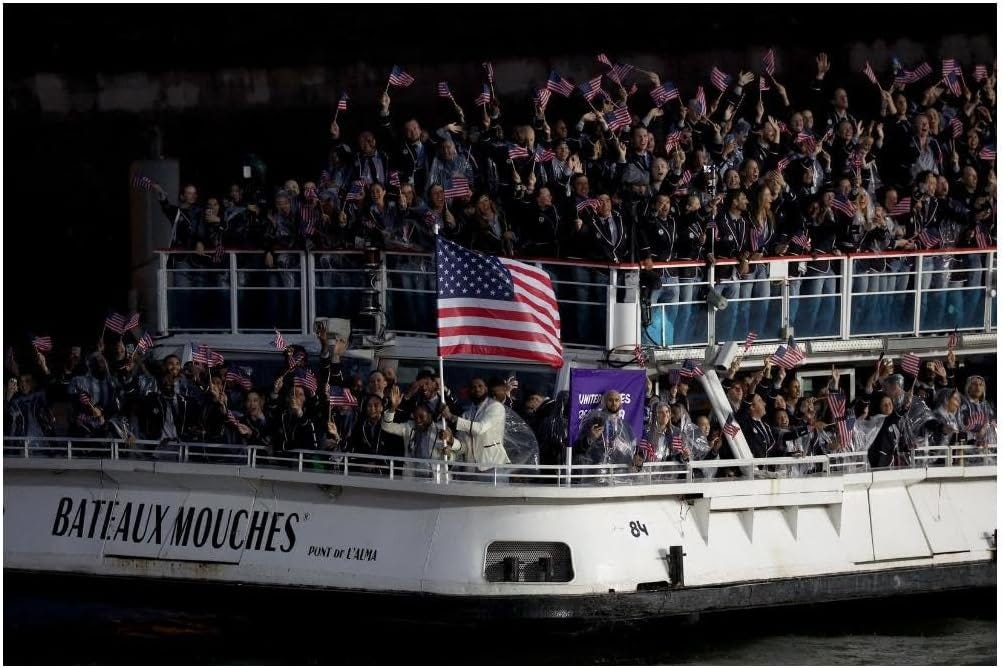
Cookouts, NBA Free Agency, and the annual ceremonial viewing of Independence Day help us to disconnect from the profoundly different ways we experience America. Black patriotism is exclusively reserved for the basketball portion of the Summer Olympics. There is a famous image of LeBron James carrying the American flag in Paris, one day I will point to it, telling my niece he’s George Washington.
A friend innocently posted a picture of the Connecticut Old State House, they remarked about how well it was decorated, ready for the holiday. It took everything in me to hold my tongue, as it’s also a site where enslaved people were frequently auctioned. Admittedly, if the party theme is Americana I’m a terrible guest to invite.
I live in Hartford, Connecticut, despite the fallacy that slavery was purely a southern enterprise, slavery propelled Hartford to “wealthiest city in the United States” status for several reasons, mainly providing property insurance to Plantation owners (Black folks being the property). It’s hard to be celebratory surrounded by monuments to a history rarely discussed.
I don’t know how it feels to be American.
America asks you to renounce your ties to home and country, swearing fealty to the ideals of love, liberty and the pursuit of happiness. Caught in the snares of a nation’s greatest con; the newly naturalized soon learn that although Lady Liberty calls for “your tired, your poor, your huddled masses yearning to breathe free…” - breathing freely very rarely follows.
Living here means reckoning with the differences in what’s written versus what’s practiced.
The calling for immigrants, while the recorded number of deportations skyrocket (regardless of administration).
The penchant for war, but the lack of support for returning soldiers.
Bailing out industries while the unhoused population rises.
Being pro-life, but providing little support once the child gets here.
Creating systems of checks and balances, but rarely checking or balancing.
Fighting for gun rights, opposing all paths to responsible gun ownership.
Being the only country in the world that accepts mass shootings as the cost of doing business.
And in a new parlor game, I’ll allow you to add more bullets of your own to this. I believe in you, Americans are great at adding bullets.
The ending was/is perfect. It leaves us all thinking through and about the bullets AND the bullets that American life is made of.